
London Council Tax Explained
How council tax works, who pays it, and how to reduce your bill
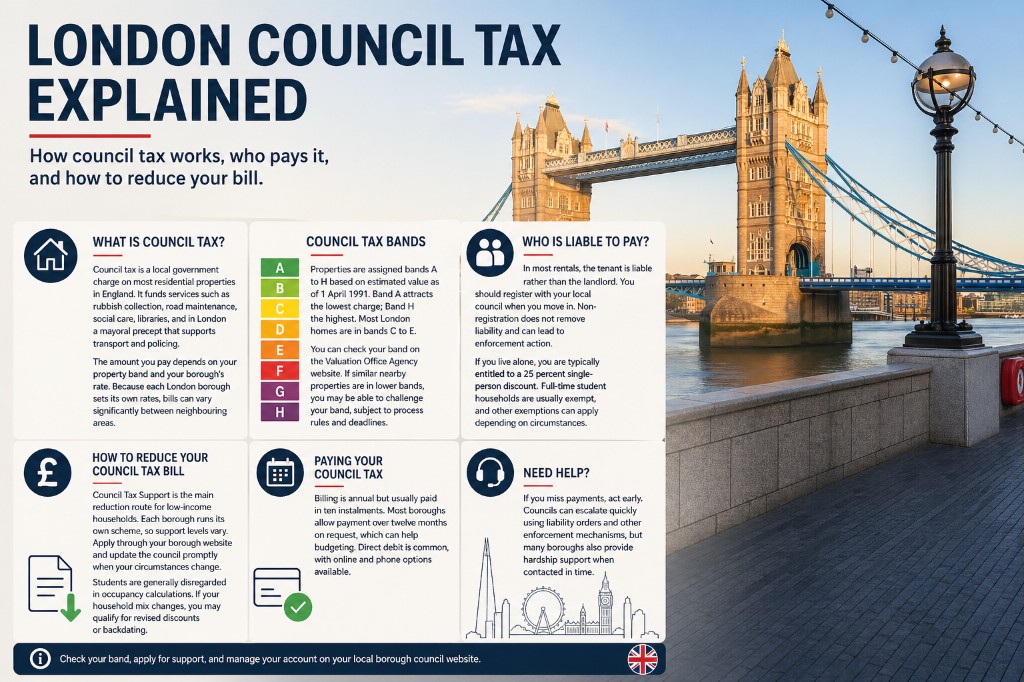
How council tax works, who pays it, and how to reduce your bill
Council tax is one of the most important and often misunderstood costs of living in London. Whether you are renting your first flat, sharing with others, or moving between boroughs, understanding how council tax works can save money and reduce stress.
This expanded guide explains both the basics and practical strategies that affect young professionals and renters across London.
What is council tax?
Council tax is a local government charge applied to most residential properties in England. It helps fund services including:
- waste collection and recycling
- road maintenance and street cleaning
- local schools and education services
- adult social care
- libraries and community services
- police and fire services
- in London, a mayoral precept supporting transport and policing
Each borough sets its own rates, so the amount can vary significantly between neighbouring areas.
How council tax is calculated
Your bill is based on two main factors:
1. Property band
Every residential property is assigned a valuation band from A to H based on estimated value as of 1 April 1991.
- Band A: lowest value and lowest tax
- Band H: highest value and highest tax
Most London properties fall in bands C to E.
2. Borough rate
Each borough sets its own annual charge for each band. That is why a Band D property can cost much more in one borough than in another.
Council tax bands explained in practice
Bands are based on 1991 values, but still drive modern bills. They reflect relative value, not current sale price.
Check your band: gov.uk/council-tax-bands
When to challenge: if similar nearby homes are in a lower band or your property appears misclassified. Note that bands can increase after review.
Who pays council tax?
In most rentals, the occupant tenant is liable rather than the landlord.
Order of liability
- resident owner-occupier
- resident tenant
- resident licensee
- owner (in specific cases, e.g. empty/special status)
When you move in, register with the local council. Not registering does not remove liability and can trigger backdated bills.
Discounts and exemptions
Single person discount
If you live alone, you usually receive 25 percent off.
Student exemption
Full-time students are usually exempt. In mixed households, students are generally disregarded for counting liable adults.
Other exemptions
Additional relief may apply in cases such as severe mental impairment, live-in carers, or qualifying unoccupied properties.
Council Tax Support (CTS)
Means-tested support for low-income households, run by each borough with local rules.
How to reduce your council tax bill
- Choose borough carefully: rates vary significantly.
- Check band before renting: include annual charge in your monthly cost model.
- Apply for discounts immediately: some are not automatic.
- Update household changes quickly: move-outs or student status can change liability.
- Request 12-month payment plan: many councils allow this on request.
Paying your council tax
Most councils issue annual bills in April and collect in 10 instalments by default. You can often request 12 instalments.
Payment methods usually include direct debit, online payment, phone and bank transfer. Direct debit is often easiest for avoiding missed payments.
What happens if you do not pay?
- missed instalment
- reminder notice
- final notice
- court summons
- liability order
- enforcement action
If you are struggling, contact the council early. Many boroughs offer payment plans and hardship routes.
Council tax and flat shares
In many flat shares, tenants are jointly liable. If one person does not contribute, others can still be pursued.
Best practice: agree payment split early, keep written records, and track transfers.
Council tax vs rent: hidden total cost
Always model total monthly cost, not rent alone.
| Area | Rent | Council Tax | Total |
|---|---|---|---|
| Zone 2 | GBP 1,200 | GBP 180 | GBP 1,380 |
| Zone 4 | GBP 1,000 | GBP 150 | GBP 1,150 |
A lower rent area can produce materially better total value when tax and transport are included.
Strategic advice for young professionals
- calculate full living cost, not rent only
- prioritise transport efficiency and weekly time cost
- check council tax band before signing
- use borough differences strategically
- review rates each year
Common mistakes to avoid
- not registering with council
- ignoring council letters
- assuming landlord always pays
- missing discount applications
- not checking band before renting
Useful questions before signing a rental contract
- Is council tax included in rent?
- What is the exact council tax band?
- Which borough council is responsible?
- Who must register the account?
- Are there any applicable discounts or exemptions?
Useful links
- Council tax overview (gov.uk)
- Check council tax band (gov.uk)
- Apply for council tax reduction (gov.uk)
- London Councils directory
Final thoughts
Council tax is not just a fixed cost; it is a variable you can manage. The most effective approach is to understand how bills are calculated, choose locations strategically, and claim all eligible reductions early.