
Moving to London: Practical Checklist
A step-by-step checklist for moving to London: documents, housing, transport, banking, healthcare, setup essentials and common mistakes to avoid.
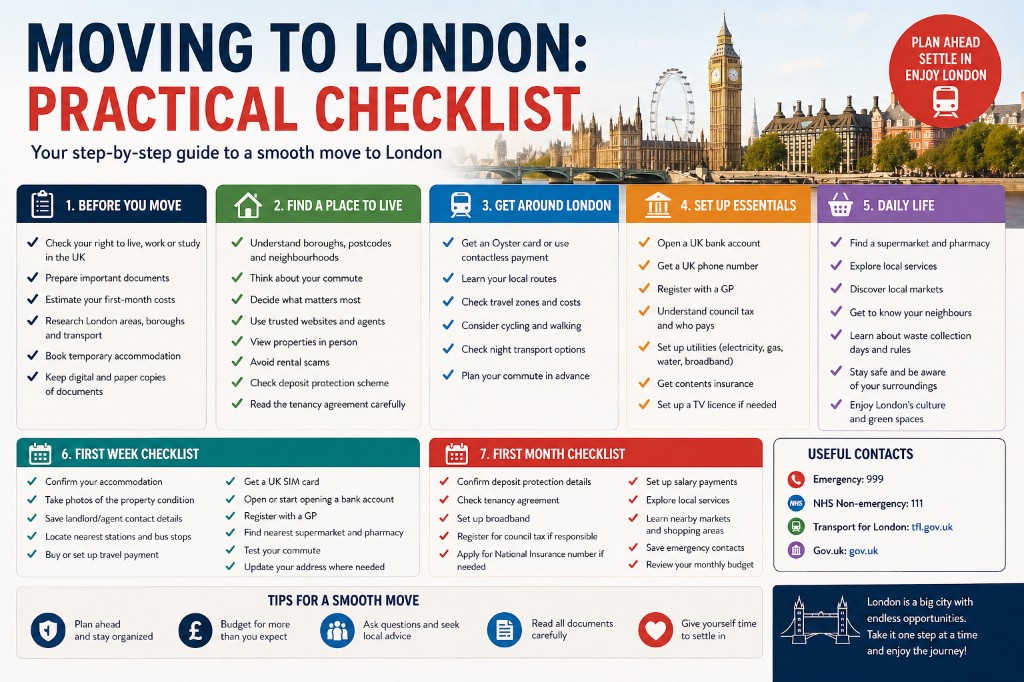
Moving to London: Practical Checklist
Moving to London can be exciting, stressful and confusing at the same time. The city offers jobs, universities, culture, transport, international communities and thousands of things to do, but it also has high rents, complex housing rules, busy transport and many local systems that may be new to you.
This practical checklist is designed for people moving to London for work, study, family, business or a new start. It explains what to prepare before you arrive, what to do in your first few days, how to find a place to live, how to set up essential services, and how to avoid common mistakes.
1. Before you move to London
The best time to make your move easier is before you arrive. London moves quickly, especially for housing and jobs.
Check your right to live, work or study in the UK
If you are not a British or Irish citizen, confirm your immigration status before making long-term plans.
- your right to work
- your right to rent
- access to public services
- study options
- how long you can stay
- whether family members can join you
Prepare digital and paper copies of documents
London applications often move fast. Keep these ready:
- passport or national ID
- visa or immigration status details, if applicable
- employment contract or job offer
- recent payslips and bank statements
- university admission letter, if relevant
- previous landlord references and proof of address
- guarantor/employer contact details
- family documents where needed
Estimate your first-month costs
| Cost | What to expect |
|---|---|
| Temporary accommodation | hotel, hostel, Airbnb or short stay |
| Rental deposit | usually up to 5 weeks' rent for many ASTs |
| First month's rent | often paid before moving in |
| Transport | Oyster/contactless, rail or bus costs |
| Food and essentials | groceries, toiletries, household basics |
| Phone/SIM | prepaid or monthly plan |
| Furniture | if the property is unfurnished |
| Emergency fund | unexpected costs or delays |
2. Choose where to live
London is not one single housing market. Compare borough, postcode and neighbourhood together.
Think about your commute first
- nearest Tube/Overground/DLR/Elizabeth/National Rail station
- walking time and bus routes
- travel zones and rush-hour time
- night transport and weekend changes
Decide what matters most
- work/university distance
- quiet streets vs nightlife
- parks, schools, childcare
- room/studio/flatshare/whole flat
- parking and total monthly budget
3. Find temporary accommodation first
If you are moving from abroad or far away, a short temporary stay reduces risk before signing long-term rent.
4. Renting in London
Demand is high, good homes move quickly, and scams exist.
Avoid rental scams
- rent far below market level
- refusal to offer proper viewing
- pressure to pay immediately
- no clear tenancy agreement or deposit protection details
5. Set up transport
Use contactless or Oyster, learn local routes, and test commute before your first work/study day.
6. Open a UK bank account
A UK account helps with salary, rent, bills and subscriptions. Use traceable payment methods for deposits and rent.
7. Get a UK phone number
You will need it for viewings, banking, job applications, GP registration and two-factor authentication.
8. Register with a GP
Register once you have an address. For emergencies call 999; for urgent non-emergency advice use NHS 111.
9. Understand council tax
Council tax is borough-based and can be a significant cost. Always check responsibility before signing tenancy.
10. Set up utilities and home services
Common services: electricity, gas, water, broadband, council tax, contents insurance, TV licence where applicable.
11. Find local services
Locate nearby supermarkets, pharmacy, GP, dentist, station, market, and emergency repair contacts.
12. Understand work basics
Keep employment and tax records organised: NI status, right-to-work proof, payroll details, tax code and payslips.
13. Moving with family
Research schools, nursery availability, commute to school, parks and family-friendly services before committing.
14. Moving as a student
Plan around campus access, accommodation timelines, guarantor requirements, council tax exemption and travel discounts.
15. Safety and practical awareness
- learn your route home
- avoid poorly lit shortcuts at night
- watch for pickpockets in crowded areas
- use licensed taxi options
- verify rental and payment links carefully
16. Build your local routine
Once basics are set, focus on repeatable routines: commute, groceries, local services, parks, and backup routes.
17. First week checklist
- confirm accommodation and document condition photos
- save landlord/agent details and key access info
- set up travel payment and test commute
- get UK SIM and begin bank account setup
- register with GP and confirm council tax responsibility
- set up utilities where needed and save emergency numbers
18. First month checklist
- confirm deposit protection and tenancy terms
- set up broadband and salary payments
- register for council tax/NI where required
- learn local services, markets and shopping routes
- review monthly budget and keep copies of bills/contracts
19. Common mistakes to avoid
- renting without proper viewing
- underestimating commute time
- ignoring council tax and bills
- paying quickly under pressure
- choosing only by postcode reputation
- not reading contract terms
20. Useful questions before signing a rental contract
- What is included in rent and bills?
- Is council tax included?
- How much is deposit and which scheme is used?
- Minimum tenancy length and notice period?
- Who handles repairs?
- Furnished or unfurnished?
- Any agency fees?
- Pets/subletting allowed?
- Broadband status and nearest transport links?
21. How CheckLondon can help
CheckLondon helps you connect boroughs, postcodes, stations, markets, rentals, services and verified businesses in one place.
22. Final moving checklist
Before arrival: confirm right to stay, prepare documents, book temporary stay, estimate budget, shortlist areas, and save emergency contacts.
After arrival: set up phone, transport, banking, view properties carefully, register GP, confirm tax/bills, and organise utilities.
After settling: build monthly budget, map local services, and review your housing setup.
Frequently asked questions
How much money should I have before moving to London?
Enough for deposit, first rent, temporary accommodation, transport, food, phone and an emergency buffer. First-month spending is usually higher than expected.
Should I rent before arriving in London?
In-person viewings are safer when possible. If remote, use trusted agencies, clear contracts and verified payment details.
What is the first thing to do after arriving?
Secure accommodation, UK phone number, transport setup and bank account, then map your local area.
Is inner or outer London better?
Inner is often faster for commuting but more expensive. Outer can offer more space and lower rent, but travel time matters.
Do I need a UK bank account to rent?
Not always, but it makes rent and bills much easier and is often expected by landlords/agencies.
How do I avoid rental scams?
Be cautious with very cheap listings, no-viewing requests, rushed payment pressure and missing contracts.
When should I register with a GP?
As soon as you have a stable address.
Do I need to pay council tax?
Many renters do, unless included in rent or exempt (for example certain full-time students).
Final thoughts
Moving to London is easier when broken into stages: prepare documents and budget, secure temporary base, choose area carefully, avoid scams, then set up transport, healthcare, banking and local services.