
Peckham Area Guide – The rise of South East London’s coolest spot
Rye Lane, Overground at Peckham Rye, food, rooftops and creative spaces — Southwark character, rent reality and where to look.
Overview
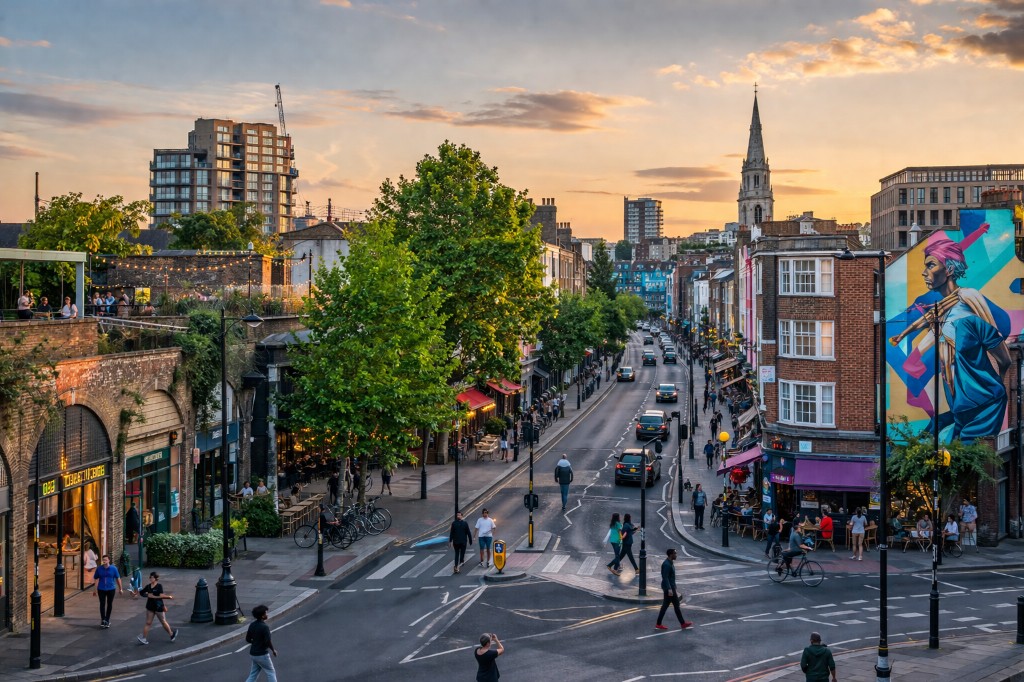
Peckham is one of South East London’s most energetic and culturally recognisable neighbourhoods: creative, diverse, noisy, stylish, food-focused, community-minded and constantly changing. It is a place of markets, rooftop bars, railway arches, independent restaurants, African and Caribbean shops, art spaces, Victorian buildings, council estates, new flats, nightlife, cafés, churches, music, buses, Overground connections and street life. For many Londoners, Peckham has become shorthand for a certain kind of South East London cool: less polished than Notting Hill, less corporate than Canary Wharf, less predictable than Clapham, and more grounded than some of the capital’s most heavily branded lifestyle districts.
But Peckham is not just “cool”. That word can flatten the area. Peckham’s appeal comes from the fact that it is layered. It has long-standing communities, especially African, Caribbean and working-class London communities, alongside artists, students, young professionals, families, independent traders and newer residents attracted by its culture and transport. It is a neighbourhood where Nigerian food shops, rooftop cinemas, railway arches, old pubs, art studios, pound shops, bakeries, barbers, creative workspaces and new apartment developments can all sit close together.
Located in the London Borough of Southwark, Peckham centres around Rye Lane, Peckham Rye station, Peckham High Street, Bellenden Road, Queen’s Road Peckham, Nunhead edges and Peckham Rye Park. It is not a neat village. It is busy, urban and sometimes messy. That is part of the attraction. People choose Peckham because it feels alive.
For renters and newcomers, Peckham offers strong lifestyle value: good food, nightlife, parks, independent culture, Overground and rail links, and access to central London without the West London price tag. But the area has become much more expensive than it used to be. Demand has risen, and with it rents, house prices and development pressure. The honest picture is this: Peckham is exciting and full of character, but it is not undiscovered, not always cheap, and not for everyone.
The character of Peckham
Peckham’s character is shaped by movement. Rye Lane is the obvious example: busy pavements, shops, buses, food stalls, phone shops, grocers, music, cafés, traders, station entrances and constant foot traffic. It can feel chaotic, but it has an energy that many London high streets have lost. Around it, side streets shift quickly into quieter residential areas, creative spaces, railway arches, cafés and pubs.
Southwark Council describes Peckham as having a historic town centre with buildings dating from the Victorian period and earlier, and says that different cultures, generations of migrants, creatives and entrepreneurs all help give Peckham its unique character. That is a useful official summary because Peckham’s identity does not come from one group or one era; it comes from overlap.
This overlap is visible everywhere. You can find long-standing family businesses beside new cafés. You can find community churches near bars and galleries. You can find residents who have lived locally for decades alongside people who moved in recently because of the nightlife and food scene. Peckham can be rough-edged, funny, fashionable, practical and loud all at once.
The area’s rise as a “cool” neighbourhood is partly linked to its creative economy. Former industrial and commercial spaces, relatively affordable rents in earlier years, and strong transport links made Peckham attractive to artists, designers, musicians and independent businesses. Over time, places like Peckham Levels, Copeland Park and the Bussey Building, and other rooftop cultural spaces helped shape a new public image of the area.
That image is powerful, but it is incomplete. Peckham is not just a destination for weekend drinks or Instagram photos. It is also a home for thousands of residents, many of whom have experienced the pressures of rising costs and redevelopment. A good area guide should recognise both: Peckham is one of London’s most exciting neighbourhoods, and one of the places where the tension between culture and gentrification is especially visible.
Rye Lane
Rye Lane is Peckham’s main artery. It is busy, imperfect and essential to the neighbourhood’s identity. It connects the station area with shops, markets, buses, restaurants, bars, railway arches and side streets leading toward Bellenden Road and Peckham Rye. If you want to understand Peckham, start with Rye Lane.
The street is not polished in the way Westbourne Grove or Upper Street are polished. That is exactly why it matters. It still feels like a working high street, not only a lifestyle strip. You can buy groceries, hair products, clothes, household items, phone accessories, food, fabric and everyday essentials. You can also find restaurants, bars and cafés that attract visitors from across London.
Rye Lane’s built environment is important too. Southwark Council has highlighted Peckham’s historic town centre and its Victorian and earlier buildings as part of the area’s character and heritage. This matters because redevelopment pressure around the station and town centre has raised questions about what should be preserved, improved or replaced.
For residents, living close to Rye Lane means convenience and energy. It also means noise, crowds and late-night activity. If you like an active high street, it is a major advantage. If you want calm, choose a side street or one of the quieter residential pockets.
Peckham Rye station and transport
Peckham is well connected, especially by rail, Overground and buses. Peckham Rye station is a major local hub. TfL lists Peckham Rye on Station Way, SE15 4RX, with London Overground information, live arrivals, status, route maps and timetables. National Rail also lists Peckham Rye station information, including staffing, help points, customer information screens and other facilities.
The station is important because Peckham does not have an Underground station. Like much of South East London, it relies on National Rail, London Overground, buses and cycling. This can be a surprise to newcomers who assume inner London always means Tube access. In practice, Peckham’s rail and Overground links are very useful, especially for journeys to London Bridge, Victoria, Blackfriars, Clapham Junction, Canada Water, Shoreditch High Street and Highbury & Islington depending on service patterns.
The Overground has also strengthened Peckham’s identity within London’s transport map. The Overground line through Peckham is part of the network that connects South and East London in ways that do not require travelling through Zone 1. This is one reason Peckham works well for people whose lives are spread across South, East and Central London.
Buses are essential too. Peckham has strong bus links to Camberwell, Elephant & Castle, New Cross, Brixton, Dulwich, Lewisham, Canada Water, London Bridge and central areas. For many residents, buses are part of everyday life.
The main transport downside is congestion and station pressure. Rye Lane and the station area can be crowded. Rail services can be busy at peak times. If you depend on a very specific commute, check the exact route before renting. A flat may look well located, but your actual journey could involve a walk, a wait, a train change and a crowded platform.
Peckham’s creative rise
Peckham’s reputation as a creative hub has grown over the past two decades. It became associated with artists, studios, independent food and drink, nightlife, galleries, rooftop venues and temporary cultural spaces. Some of this emerged because earlier rents and underused buildings allowed experimentation. Some of it came from the area’s existing diversity and energy. Some came from wider East and South London shifts as creative workers looked beyond more expensive neighbourhoods.
Peckham Levels is one of the clearest examples. It is housed in a former multi-storey car park and now offers studios, events, food, drink, karaoke, workspace and venue hire. Its own site describes it as part of The Trampery family, with studios, events, food and drink, and workspace. Time Out London has described Peckham Levels as a transformed multi-storey car park and a vibrant mix of art, food, music, culture, enterprise and creativity.
Nearby cultural spaces and venues have also shaped the area’s reputation. Copeland Park and the Bussey Building are often associated with music, events, food, markets and creative businesses. Rooftop venues have helped build Peckham’s image as a place for sunset drinks and skyline views. Bold Tendencies, based on the top levels of a multi-storey car park, is another important cultural project, known for art, music and performance.
This creative rise has made Peckham attractive to visitors and renters. But it has also pushed prices up. The challenge for the area is whether it can remain genuinely creative and accessible while becoming more desirable and expensive. If the people and businesses that made Peckham interesting are priced out, the area risks becoming a copy of itself.
Food, restaurants and cafés
Peckham is one of South London’s best food neighbourhoods. Its food scene reflects both long-standing communities and newer restaurant culture. You can find Nigerian, Ghanaian, Caribbean, Turkish, Vietnamese, Italian, modern British, vegan, bakery, brunch, street food, pizza, small plates, pubs and late-night food. This range is one of the strongest reasons to live locally.
Unlike more polished restaurant districts, Peckham’s food scene is mixed. Some places are simple and functional. Others are highly designed and destination-led. Some are aimed at local communities. Others attract food-focused Londoners from across the city. This mixture keeps Peckham interesting.
Rye Lane and the surrounding streets are especially important for African and Caribbean food shops, grocers and restaurants. Bellenden Road has a more village-like café and restaurant feel. Copeland Park and the station area add bars, food pop-ups and social venues. The result is a neighbourhood where eating out can mean very different things depending on budget, mood and exact location.
For residents, this is a major lifestyle advantage. The downside is that eating out can become expensive, especially in newer restaurants and bars. Peckham can feel casual, but casual does not always mean cheap. A realistic budget should separate groceries, local everyday food and social dining.
Nightlife and social life
Peckham’s nightlife is one of its biggest draws. The area has pubs, cocktail bars, music venues, rooftop spaces, club nights, casual drinking spots and late-night food. It is not as central as Soho or as club-heavy as parts of Shoreditch, but it has a distinctive South East London social scene.
The nightlife feels less corporate than some areas. It is often creative, mixed and informal. People come for drinks, music, events, exhibitions, food and rooftop views. On warm evenings, Peckham can feel like one of London’s most sociable neighbourhoods.
The trade-off is noise and street pressure. If you live very close to busy venues, railway arches or late-night streets, the lifestyle may be less romantic than it appears on a weekend visit. Renters should visit potential streets at night, especially Friday and Saturday. A flat that looks ideal in daylight may feel very different when the bars close.
For people who want social life within walking distance, Peckham is excellent. For people who want quiet, it requires careful micro-location.
Housing and where to live
Peckham’s housing is varied. You can find Victorian terraces, converted flats, council estates, ex-local authority flats, newer apartment schemes, maisonettes, shared houses and period homes. The area’s housing market has become more competitive as its reputation has grown.
For renters, shared housing is common. Peckham attracts young professionals, creatives, students, couples and people priced out of more central or west London areas. One-bedroom flats can be expensive compared with what Peckham cost historically, but may still feel better value than areas such as Islington, Notting Hill or Clapham depending on the property.
The best place to live depends on lifestyle:
- Rye Lane and station area: best for transport, food, nightlife and energy, but busy and noisy.
- Bellenden Road: more polished, village-like and desirable, with cafés and restaurants.
- Peckham Rye Park side: greener and more residential, good for families and people wanting calm.
- Queen’s Road Peckham: practical, transport-focused, sometimes better value, with links toward New Cross and Surrey Quays.
- Nunhead edge: quieter, more residential and often more village-like.
- Camberwell edge: good for buses, food and more urban South London character.
Bellenden Road is often seen as one of the area’s more desirable residential pockets. It has cafés, restaurants, independent shops and attractive streets. It can feel calmer and more curated than Rye Lane, and prices often reflect that.
Queen’s Road Peckham offers another station and a slightly different transport pattern. It can be practical for commuters and may offer better value than the most fashionable Peckham streets.
Peckham Rye Park side is attractive for people who want access to green space. Families and dog owners may prefer this side, though the walk to the station can be longer depending on exact location.
Peckham Rye Park and green space
Peckham is urban, but it has valuable green space nearby. Peckham Rye Park and Common sit to the south of the main town centre and provide open space, paths, gardens, sports areas and places to walk, run or relax. For residents, the park is one of the best ways to balance the intensity of Rye Lane and the nightlife scene.
Peckham Rye Park gives the area a family and lifestyle dimension beyond food and bars. It supports dog walking, weekend strolls, running, children’s play and summer picnics. Living within walking distance of the park can change the whole experience of Peckham.
The area is also close to other South East London green spaces depending on location, including Nunhead Cemetery, Burgess Park, Goose Green and Dulwich Park further south-west/south. This makes Peckham more liveable than people sometimes assume from the busy town centre alone.
If green space matters, choose your micro-location carefully. The difference between living beside the park and living directly off Rye Lane is significant.
Community and identity
Peckham’s community identity is one of its strongest features. The neighbourhood is shaped by generations of migrants, independent traders, churches, markets, artists, families and long-term residents. Southwark Council explicitly recognises that different cultures, migrants, creatives and entrepreneurs help give Peckham its unique character.
This is important because Peckham’s “coolness” did not appear from nowhere. It grew from an already active, diverse and resilient neighbourhood. New cafés and rooftop bars may attract attention, but Peckham’s deeper identity includes African and Caribbean businesses, faith communities, street traders, long-standing residents, local schools and community networks.
Newcomers should approach Peckham with respect for that history. It is fine to enjoy the restaurants, bars and culture, but it is also important to understand that rising rents and redevelopment can put pressure on the communities that made the area distinctive.
Peckham’s future depends on balance. It needs investment, better public spaces, safer streets and improved transport. But it also needs to protect local character, independent traders and affordability where possible.
Regeneration and change
Peckham has seen significant regeneration pressure, especially around the station and town centre. Southwark Council has been working on preserving Peckham’s character and heritage while developing the area. Local campaigns have also focused on protecting historic buildings and ensuring that redevelopment benefits the community rather than erasing the area’s identity.
This is one reason Peckham is often discussed in relation to gentrification. New developments can bring better public space, safer streets, improved buildings and more housing. But they can also bring higher rents, displacement and a loss of local businesses. The question is not whether Peckham should change — all London neighbourhoods change — but who benefits from that change.
For renters, regeneration can be a double-edged sword. Improved streets and transport can make the area better to live in. But they can also push rents higher. If you are moving to Peckham now, you are entering a neighbourhood in transition, not a finished product.
Transport pros and cons
Peckham’s transport is better than some people expect, but different from Tube-based areas. The lack of Underground can be a disadvantage for newcomers who want simple Zone 1 Tube access. However, Overground and rail links are genuinely useful, especially for South, East and Central London routes.
The Overground is particularly valuable for people travelling to Canada Water, Shoreditch, Highbury & Islington and Clapham Junction. National Rail links can be useful for London Bridge, Victoria and Blackfriars depending on service. Buses fill many gaps.
Cycling is also common, especially for journeys to Camberwell, Bermondsey, London Bridge, New Cross, Dulwich and central areas. But road quality and traffic vary, so route choice matters.
The main transport advice is practical: test your commute. Do not assume Peckham is inconvenient because it has no Tube, and do not assume it is perfect because it has Overground. Your exact route matters.
Cost of living
Peckham is no longer cheap. It may still offer better value than prime West or North London, but its popularity has changed the market. Rent is the main cost, followed by council tax, utilities, transport, groceries and social spending.
The social spending risk is high because Peckham makes it easy to go out. Bars, restaurants, cafés, market food, events and rooftop venues are part of the appeal. If you live locally and say yes to everything, monthly spending can rise quickly.
Groceries can be more manageable because Peckham has a strong range of food shops and everyday retailers. Residents who cook at home can control costs better than those relying on restaurants and delivery apps.
For renters, shared housing remains the easiest way to access the area. A room in a shared flat or house may be manageable for many professionals. Renting alone in a one-bedroom flat can be significantly more expensive. Couples may find Peckham more affordable because costs are split.
A realistic monthly budget should include rent, bills, council tax, transport, groceries, eating out, subscriptions, fitness and savings. Peckham’s informal feel can hide the fact that it is now a competitive inner London rental market.
Safety and street feel
Peckham is busy and urban. Some parts feel lively and safe because there are always people around. Other parts can feel intense, especially late at night or around busy roads. Street feel changes quickly between Rye Lane, residential side streets, park edges and quieter areas.
As with any major London neighbourhood, safety is street-specific and time-specific. Visit potential homes during the day and at night. Walk from the station to the property. Check lighting, noise, traffic and nearby venues. A flat five minutes from the station can be excellent or stressful depending on the route.
Peckham is not a quiet suburban neighbourhood. It is a dense, active urban area. For many people, that energy is exactly the point. For others, it can be tiring.
Who Peckham suits
Peckham suits people who want culture, food, nightlife, diversity and creative energy. It is ideal for renters who like active streets, independent businesses, bars, markets, art spaces and strong transport without living in central London. It works well for young professionals, creatives, students, couples, sharers and people who want South East London identity.
It can also suit families, especially near Peckham Rye Park, Nunhead edges or quieter residential streets. But families should be selective about micro-location, schools, parks and space.
Peckham may not suit people who want quiet, polished streets, low rent or simple Tube access. It is not the easiest neighbourhood. But for the right resident, it is one of London’s most rewarding.
Pros of living in Peckham
- Atmosphere: food, nightlife, markets, art, transport, parks and identity.
- Independence: feels independent and alive.
- Connectivity: access to South and East London through rail and Overground.
- Creativity & community: strong creative scene and deep community history.
- Variety: nightlife, park-side calm, Bellenden polish, Queen’s Road practicality — choose your pocket.
Cons of living in Peckham
- Cost: no longer cheap.
- Noise & crowding: busiest strips can be intense.
- No Tube: transport is rail, Overground and bus-led.
- Uneven streets: micro-location matters.
- Gentrification pressure: affects culture and affordability.
Some people visit Peckham for a night out and fall in love with it, then realise living there requires more patience. The area is exciting, but also busy and sometimes messy.
Nearby alternatives
If you like Peckham but want a different balance, consider Nunhead for a quieter village-like feel, Camberwell for food and buses with strong student/arts energy, New Cross for music and Goldsmiths-related culture, Deptford for markets and creative growth, East Dulwich for a more polished family-friendly feel, or Brixton for stronger Tube access and nightlife.
Each alternative changes the balance between cost, transport, culture and calm.
Final verdict
Peckham’s rise is real. It has become one of South East London’s most exciting neighbourhoods because it combines culture, food, nightlife, diversity, creative spaces and strong local identity. It is cool because it is layered, not because it is perfect. It has history, communities, markets, railway arches, parks, rooftops, restaurants and streets that feel alive.
For renters and newcomers, Peckham is a strong choice if you want energy, character and South East London culture. It is less suitable if you want quiet luxury, low rent or simple Tube access. The best experience depends heavily on micro-location: Rye Lane for energy, Bellenden Road for polish, park edges for calm, Queen’s Road for practicality, Nunhead edges for residential balance.
The honest summary is this: Peckham is one of London’s most interesting neighbourhoods because it still feels like a place with its own voice. Its challenge is keeping that voice while rents rise and redevelopment continues. For the right resident, Peckham offers one of the most vibrant versions of London life: creative, social, diverse and unmistakably South East.