
Stratford Area Guide – Post-Olympics regeneration and value for money
Newham: Elizabeth line, Olympic Park, Westfield and East Village — East London connectivity, modern flats and practical living.
Overview
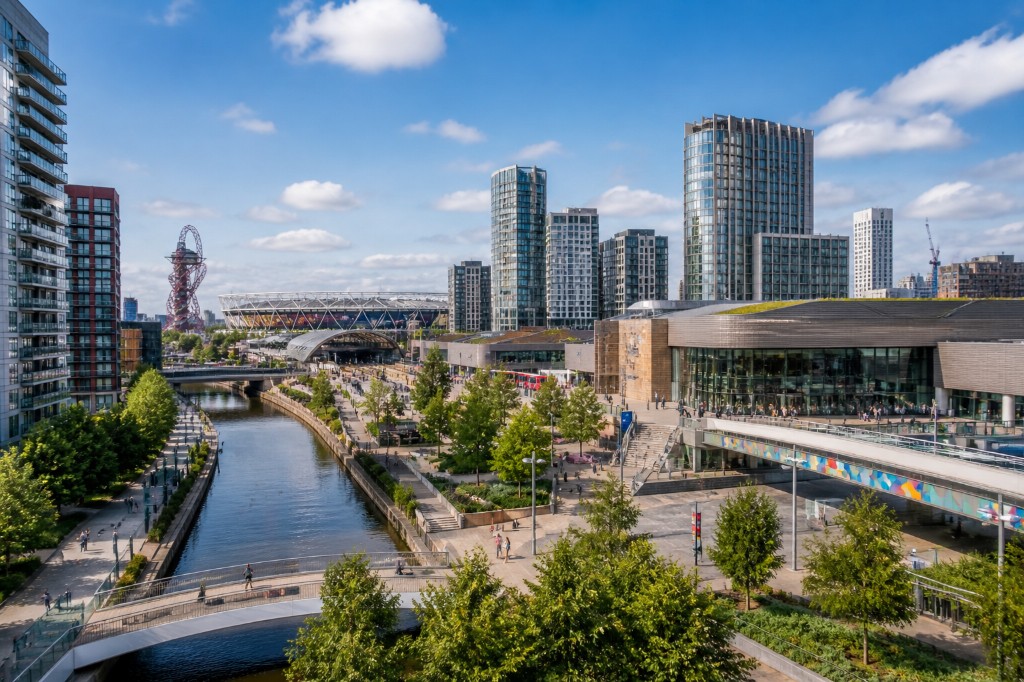
Stratford is one of East London’s biggest regeneration stories. Once known mainly as a busy transport interchange and a working East London town centre, it was transformed by the London 2012 Olympic and Paralympic Games, the creation of Queen Elizabeth Olympic Park, the arrival of Westfield Stratford City, major new housing schemes, upgraded transport, new cultural institutions and a growing business district. Today, Stratford is one of the most practical places to live in East London if you want transport, shopping, parks, modern flats and better value than many more central neighbourhoods.
The area sits in the London Borough of Newham, close to Hackney Wick, Leyton, Bow, Forest Gate, Maryland, West Ham, Canning Town and the Olympic Park. It is not a village-like neighbourhood in the way Greenwich or Wimbledon can be. It is bigger, busier, more mixed and more urban. Stratford has shopping centres, high-rise residential towers, older streets, large estates, student accommodation, major sports venues, rail platforms, bus stations, hotels, construction sites, offices, parks, canals, restaurants and a huge volume of people moving through it every day.
For renters and newcomers, Stratford’s biggest advantage is connectivity. Few London areas offer such a mix of transport: Elizabeth line, Central line, Jubilee line, DLR, London Overground, National Rail and buses. TfL lists Stratford as a Zone 2/3 station on the Elizabeth line, and the Elizabeth line route page shows Stratford connecting with the Central line, Jubilee line and DLR.
The second advantage is value for money. Stratford is not cheap anymore, but compared with areas such as Canary Wharf, Islington, Notting Hill, Shoreditch or parts of Hackney, it can still offer more space, newer flats and stronger transport for the price. The trade-off is that Stratford can feel busy, commercial and less traditionally charming. It is a regenerated urban hub, not a quiet heritage district.
The honest picture is this: Stratford is one of the best areas in London for practical living if your priorities are transport, shopping, modern housing and access to green space. It is less ideal if you want old architecture, village streets, boutique charm or a calm residential atmosphere everywhere. Its strength is usefulness.
The character of Stratford
Stratford’s character is shaped by change. It is a place where old East London meets large-scale regeneration. Around the older town centre, you still find everyday shops, local services, buses, markets, older housing, takeaways and a busy working high street feel. Around Westfield and Stratford International, the atmosphere becomes more modern, commercial and polished. Around Queen Elizabeth Olympic Park, it opens into wide boulevards, waterways, sports venues, landscaped parkland and new apartment districts. Around East Village and Chobham Manor, it feels more residential and planned.
This variety can be confusing for newcomers. “Stratford” can mean very different lifestyles depending on where you live. A flat beside Westfield feels different from a house near Maryland, a modern apartment in East Village, a room near Leyton Road, or a home close to West Ham Park. This is why micro-location matters.
The area does not have the classic prettiness of Notting Hill or Greenwich. Its appeal is more functional. It is a place where you can commute easily, shop easily, reach the airport relatively efficiently, access parks, go to events, use the Olympic facilities, and live in a modern flat without being deep in outer London. For many renters, that is a strong proposition.
Queen Elizabeth Olympic Park describes itself as a living legacy of sustained investment, place leadership and partnership, and says it has become a significant economic hub for east London. That description captures Stratford’s current role: it is not only a residential area, but a major regeneration and growth zone.
The downside is that regeneration can feel uneven. Some parts are shiny and well-managed; others still feel busy, congested or unfinished. Stratford is not a perfectly polished district. It is a large, active, evolving part of London.
Post-Olympics regeneration
Stratford’s modern identity is inseparable from the 2012 Olympic and Paralympic Games. The Olympic project brought investment in transport, public realm, housing, venues, landscaping and infrastructure. The London Legacy Development Corporation was established in 2012 to take forward commitments from the original London 2012 bid around the physical and socio-economic regeneration of Stratford and surrounding areas.
Queen Elizabeth Olympic Park is the clearest legacy. It contains parklands, waterways, sports venues, cultural spaces and new residential areas. The park says the London 2012 legacy has “come to life” across 560 acres of parklands, landscaped gardens, historic waterways, sporting venues, arts and events programmes and the ArcelorMittal Orbit visitor attraction.
The regeneration story matters because it changed Stratford’s position in London. Before the Games, many people saw Stratford as a transport hub rather than a desirable residential destination. After the Games, it became a major East London centre, with new flats, better public space, the Olympic Park, Westfield, universities, cultural projects and stronger connections to central London and Canary Wharf.
This does not mean all problems disappeared. Regeneration can bring higher rents, pressure on long-standing communities, construction disruption, uneven benefits and a sense that the new parts of Stratford are disconnected from the older town centre. Some residents feel the area has improved dramatically. Others worry about affordability and local identity. Both views can be true.
For renters, the key point is practical: Stratford now offers a housing and transport package that would have been much harder to imagine before the Olympics. The area’s value comes from that transformation.
Queen Elizabeth Olympic Park
Queen Elizabeth Olympic Park is one of Stratford’s biggest lifestyle assets. It gives the area large-scale green space, walking routes, waterways, sports facilities and visitor attractions. For residents, it provides a daily escape from the intensity of the station, roads and shopping centre.
The Park includes major venues such as London Stadium, London Aquatics Centre, Copper Box Arena and the Lee Valley VeloPark. It also includes gardens, play areas, paths, bridges, canals and event spaces. For families, runners, cyclists and people who want outdoor space, this is a major advantage.
The park changes Stratford’s quality of life. Without it, Stratford would be mostly a transport and retail hub. With it, the area becomes more liveable. Residents can walk, run, cycle, attend events, use sports facilities, sit by the water or cross into Hackney Wick and Fish Island. It gives the area breathing room.
The park also helps Stratford compete with greener residential districts. It is not the same as Richmond Park, Wimbledon Common or Greenwich Park, but it is a major urban park built for modern East London. Its landscape is more designed and contemporary, with broad paths and open spaces rather than historic woodland or old village charm.
For people comparing Stratford with Canary Wharf, Canning Town, Bow, Leyton or Hackney Wick, Olympic Park access can be a major deciding factor.
Westfield Stratford City
Westfield Stratford City is one of the area’s most practical advantages. It gives residents access to a huge range of shops, restaurants, supermarkets, services, cafés, entertainment and leisure facilities within walking distance of the station. Westfield describes Stratford City as offering more than 200 shops and restaurants and calls it one of London’s most accessible retail destinations, located close to major transport hubs.
For daily life, this is convenient. You can buy groceries, clothes, electronics, cosmetics, household goods, gifts and food without travelling into central London. Westfield’s food and drink offer is also large: its restaurant listings describe around 100 restaurants and food options, from quick meals to sit-down dining.
The downside is that Westfield can dominate the area. Some people like the convenience; others find it too commercial and mall-like. If your idea of London living is independent cafés, old pubs and street markets, Westfield may feel generic. If your priority is practicality, weather-proof shopping and choice, it is a major benefit.
The presence of Westfield also supports Stratford’s value proposition. In many areas, good transport and shopping are separate. In Stratford, they are directly connected. You can come out of the station, shop, eat, meet friends, go to the cinema, then walk home.
Transport connections
Transport is Stratford’s strongest selling point. Few London neighbourhoods can match its range of connections. Stratford has Elizabeth line, Central line, Jubilee line, DLR, London Overground, National Rail and bus links. Stratford International adds more rail and DLR options, although the name can mislead newcomers because international Eurostar services do not stop there.
The Elizabeth line has made Stratford even more useful. TfL’s Elizabeth line information lists Stratford in Zones 2/3, and the Elizabeth line route connects Stratford with Central, Jubilee and DLR services. The Elizabeth line improves access westward through central London and eastward toward Shenfield, depending on service patterns.
The Central line provides fast access to Liverpool Street, Bank, St Paul’s, Holborn, Tottenham Court Road, Oxford Circus and west London. The Jubilee line connects Stratford to Canary Wharf, London Bridge, Waterloo, Westminster, Green Park and Bond Street. The DLR connects Stratford to Docklands, Canary Wharf-related areas and routes toward Canning Town, Woolwich Arsenal, Lewisham and Beckton depending on branch. TfL lists Stratford DLR as part of the Docklands Light Railway network.
This means Stratford works for many commuters: City workers, Canary Wharf employees, West End workers, university students, hospital staff, retail workers, airport travellers, media workers and people with hybrid jobs across London.
The trade-off is crowding. Stratford station is one of London’s busiest transport hubs. Peak times can feel intense. Platforms, entrances and the Westfield connection can be crowded. If you want a quiet station experience, Stratford may frustrate you. If you want options and speed, it is excellent.
Housing and where to live
Stratford’s housing market is varied. You can find modern high-rise flats, new-build apartment schemes, former Olympic Village homes, older terraces, ex-local authority flats, shared houses, student accommodation and family homes in surrounding areas. The housing offer is one of Stratford’s strongest value points because newer apartments are often more available here than in older inner London districts.
East Village is one of the most important residential areas. Originally the athletes’ village for London 2012, it is now a planned residential neighbourhood with apartments, shops, public spaces and access to the Olympic Park. It suits renters who want modern flats, managed public realm, green space and proximity to transport.
Stratford town centre offers convenience, but can feel busy. Living close to the station means easy commuting, but also crowds, traffic and less calm. Around Maryland, the area becomes more residential and may offer slightly better value, with Elizabeth line/National Rail access depending on exact location. Toward Leyton, Bow and West Ham, prices and street feel change again. Around the Olympic Park and Stratford International, the atmosphere becomes more modern and planned.
The best rental choice depends on priorities:
- Near Stratford station: best for transport and shopping, but busiest.
- East Village: best for modern flats, park access and planned living.
- Stratford International/Olympic Park side: best for new-build lifestyle and green space.
- Maryland: practical, slightly more local and potentially better value.
- Forest Gate edge: more residential, Elizabeth line access nearby and growing appeal.
- Leyton edge: often better value, with Central line access and residential streets.
- West Ham/Bow edge: more mixed, potentially better value and useful transport.
Stratford’s housing value is strongest when you compare total package: transport, flat quality, space, amenities and rent. A modern flat in Stratford may give better overall practicality than a smaller, older flat in a more fashionable area.
East Village and new neighbourhood living
East Village is central to Stratford’s post-Olympic residential story. It represents a more planned version of London living: modern apartment blocks, landscaped public spaces, shops, cafés, schools, health services and quick access to the park. For renters who want a clean, modern and managed environment, it can be attractive.
The advantages are comfort and convenience. Flats tend to be newer, with better layouts, insulation, lifts and amenities than many older London conversions. The streets are wider and more planned. The park is nearby. Stratford International and Westfield are within reach.
The disadvantage is that some people find it less organic than older London neighbourhoods. It can feel like a new district rather than a place shaped over generations. That may be a positive or negative depending on taste. If you want the energy of Hackney or Brixton, East Village may feel too controlled. If you want a practical flat and calmer streets, it may be ideal.
Value for money
Stratford’s biggest argument is value for money. It is not cheap, but it can offer a lot for the rent compared with many London areas. The combination of transport, shopping, green space and modern housing is hard to match.
A renter might choose Stratford because they can get a newer flat, better transport, lift access, bike storage or a balcony for a similar price to an older, smaller flat elsewhere. A family might choose the area because of park access and schools in newer residential districts. A professional might choose it because of fast links to Canary Wharf, the City and the West End.
However, value is relative. Stratford has become more expensive since the Olympics and Elizabeth line improvements. New-build flats can carry premium rents. Some developments may have high service charges for buyers. The area is not a bargain in the old sense. It is better understood as “high utility for the price”.
The best way to judge value is to compare monthly cost against lifestyle benefits: rent; transport time; transport cost; flat size; building quality; access to green space; shopping convenience; commute reliability; social life; safety and comfort.
Stratford often scores strongly on practical categories, even if it does not score as highly on charm.
Food, shopping and daily life
Stratford is very convenient for daily life. Westfield provides a huge retail and food offer. The older town centre adds everyday shops, local services, supermarkets, takeaways, markets and lower-cost options. This mix means residents are not dependent only on premium shopping.
Food options are broad. Westfield has chain restaurants, casual dining and food court-style options. The older Stratford town centre and surrounding areas offer more local and international food. Nearby Hackney Wick, Leyton, Forest Gate and East Ham expand the food scene further.
The restaurant culture is more practical than romantic. Stratford is not yet a dining destination in the same way Hackney, Soho or Brixton can be. But it is easy. For many residents, that matters more.
Everyday errands are extremely simple. This is one of Stratford’s biggest strengths. You can shop, commute, eat, exercise, attend events and use parks all within a compact area.
Culture, sport and entertainment
Stratford benefits from the Olympic legacy and newer cultural development. London Stadium hosts football, athletics and major events. The London Aquatics Centre and Copper Box Arena provide sports facilities. The park hosts events, festivals and community activities. The ArcelorMittal Orbit is a visitor attraction and visual landmark.
The area has also gained cultural weight through the East Bank development on Queen Elizabeth Olympic Park, bringing major cultural and educational institutions to the area. This wider development supports Stratford’s transition from transport and retail hub to a more complete cultural district.
Hackney Wick nearby adds creative spaces, breweries, restaurants, canalside venues and nightlife. This is important because Stratford itself can feel commercial, but Hackney Wick provides a more independent and creative edge within walking or cycling distance.
For residents, the result is a useful blend: mainstream shopping and entertainment in Westfield, sport and events in the Olympic Park, and more creative nightlife nearby.
Schools and family living
Stratford is increasingly family-friendly, especially around East Village, Chobham Manor, Olympic Park and residential streets away from the busiest roads. New housing, schools, parks and sports facilities have improved the family offer. The park gives children outdoor space, and Westfield provides practical shopping and services.
Families should still research schools and catchments carefully. Stratford is a large and varied area, and school choice depends on exact address. Some streets feel more family-oriented than others. East Village and Olympic Park edges may appeal to families who like modern flats and planned public spaces. Older residential areas may offer more traditional housing but vary in quality and street feel.
The main family trade-off is space versus environment. Stratford may offer modern flats and parks, but not always the same quiet residential feel as Wimbledon, Greenwich, Dulwich or Blackheath. Families who want gardens may look toward Leyton, Forest Gate, Wanstead, Walthamstow or further into East London.
Green space and outdoor life
Queen Elizabeth Olympic Park is Stratford’s main green asset. It provides large-scale outdoor space, waterways, gardens, sports venues and walking routes. It is especially valuable because Stratford’s town centre can feel busy and hard-surfaced. The park gives balance.
Residents can walk, run, cycle, use sports venues, visit playgrounds, attend events or cross into Hackney Wick and the canal network. The waterways and landscaping make the area feel more open than many dense transport hubs.
Other green spaces are available nearby, including West Ham Park, Victoria Park further west, Hackney Marshes and local parks depending on location. But Olympic Park is the central advantage.
If outdoor lifestyle matters, choose accommodation on the Olympic Park or East Village side rather than directly in the busiest town centre streets.
Cost of living
Stratford’s cost of living depends heavily on housing choice. New-build flats near the station, Olympic Park or East Village can be expensive, but may offer better quality than older flats elsewhere. Older housing further from the station may be more affordable. Shared housing can reduce costs for younger renters.
Transport can be cost-effective because Stratford is in Zones 2/3 and has many routes. People working in Canary Wharf, the City, central London or Stratford itself may benefit from shorter commutes. Hybrid workers may use contactless pay-as-you-go rather than fixed passes.
Food and shopping can be controlled. Westfield includes many mid-range options, while older Stratford and surrounding East London areas offer everyday shops and lower-cost food. The risk is lifestyle spending in the shopping centre: restaurants, shopping, cinema, coffee and impulse purchases can add up.
A realistic budget should include rent, council tax, utilities, broadband, mobile, transport, groceries, eating out, fitness, subscriptions and savings. Stratford can be good value, but only if the rent is sensible and the convenience does not lead to constant spending.
Safety and street feel
Stratford is busy and urban. Around the station, Westfield and town centre, there are large crowds, commuters, shoppers and visitors. This can feel safe because there are always people around, but it can also feel intense. Some streets are calmer, especially around East Village and the Olympic Park.
As with any London area, street feel varies. The new developments may feel clean and managed. Older areas can feel more mixed. Main roads can be noisy. Station areas can be crowded late into the evening.
For renters, the best advice is to visit at different times: weekday rush hour, weekend afternoon and evening. Walk the route from station to home. Check lighting, traffic, noise and how the building entrance feels.
Stratford is not a quiet village. It is a major urban centre. If you accept that, it can be very practical.
Who Stratford suits
Stratford suits people who value transport, shopping, modern housing and green space. It works well for professionals commuting to Canary Wharf, the City, central London or Stratford itself. It suits renters who want newer flats without paying Canary Wharf prices. It suits families who like Olympic Park access and modern neighbourhoods. It suits students and workers who need multiple transport options.
It may not suit people who want old architecture, quiet streets, boutique village atmosphere or a strong independent high-street culture. Stratford is useful more than romantic.
Pros of living in Stratford
- Transport: among London’s best-connected areas — Elizabeth, Central, Jubilee, DLR, Overground, rail.
- Convenience: Westfield, older town centre, parks, sports venues and services nearby.
- Housing choice: especially modern flats.
- Olympic Park: major green and leisure asset.
- Value: relative to many pricier or less practical inner districts.
- Reach: central London, Canary Wharf, East London and airports easier than from many neighbourhoods.
Cons of living in Stratford
- Atmosphere: can feel busy, commercial or impersonal.
- Crowding: station and Westfield at peak.
- Uneven feel: between regenerated and older areas.
- Rising rents: popularity has pushed prices up.
- New districts: some developments can feel disconnected from older Stratford.
If you want charm, you may prefer Greenwich, Walthamstow Village, Hackney, Islington or Blackheath. If you want pure convenience, Stratford is hard to beat.
Nearby alternatives
If you like Stratford but want different trade-offs, consider Hackney Wick for creative canalside living, Leyton for better value and Central line access, Forest Gate for Elizabeth line and residential streets, Bow for East End character and transport, Canning Town for new builds and Jubilee line access, or Canary Wharf for a more corporate waterside lifestyle.
Each alternative changes the balance between price, transport, lifestyle and housing type.
Final verdict
Stratford is one of London’s strongest examples of post-Olympics regeneration. It has changed from a practical East London interchange into a major residential, retail, transport and leisure hub. Queen Elizabeth Olympic Park, Westfield Stratford City, the Elizabeth line, new housing and improved public spaces have made it one of the most useful places to live in East London.
It is not perfect. It can be crowded, commercial and uneven. It does not have the historic charm of Greenwich, the nightlife identity of Brixton or the boutique feel of Islington. But it offers something very valuable: transport, modern flats, green space, shopping and relative value in one place.
The honest summary is simple: Stratford is not London’s most romantic neighbourhood, but it may be one of its most practical. For renters and newcomers who want strong connections, newer housing, Olympic Park access and better value for money than many inner districts, Stratford is a serious option.