
Best Ways to Get Around London Without a Car
Tube, buses, Overground, Elizabeth line, cycling, walking, river travel, ULEZ and why most Londoners do not need a car.
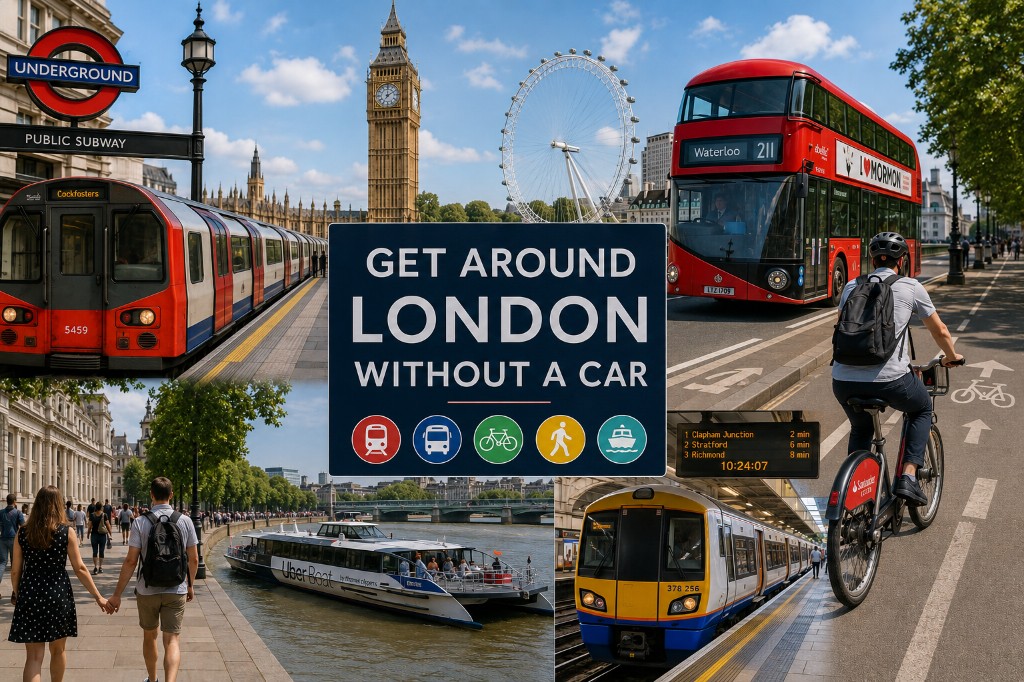
Overview
London is one of the few global cities where owning a car is not only unnecessary — it can actually be inconvenient and expensive. Between the Congestion Charge, parking restrictions, heavy traffic and the Ultra Low Emission Zone (ULEZ), driving in the capital is rarely the easiest option. Fortunately, London offers one of the most comprehensive public transport and active travel networks in the world.
If you are moving to London, visiting for an extended period, or simply wondering how locals manage without cars, this guide explains the smartest, fastest and most affordable ways to get around the city. For payment, zones, caps and tapping rules, start with our Transport basics guide.
London’s public transport system is integrated, extensive and surprisingly user-friendly once you understand the basics. The key is knowing when to use each option.
The Tube (Underground)
The Underground, commonly called the Tube, is the backbone of London transport. It connects central districts with outer zones through a network of colour-coded lines. For newcomers, the Tube may look complex at first, but its map is designed for clarity rather than geography. Trains run frequently, especially in central areas, and during peak hours services arrive every few minutes.
The Tube is particularly effective for longer cross-city journeys. If you need to travel from north to south or east to west across multiple zones, it is often the fastest option. Stations are clearly signposted, and announcements inside trains help you follow progress. Contactless bank cards, Oyster cards, or mobile payment systems allow seamless entry and exit — simply tap in at the gates and tap out when you leave.
However, the Underground does not reach every part of London evenly. South London, for example, has fewer Tube lines compared to the north. That is where buses become essential. Explore Stratford, King’s Cross or Canary Wharf on CheckLondon to see how major hubs connect rail, bus and walking routes.
Buses
London’s bus network is one of the largest in the world. Red double-decker buses operate across nearly every neighbourhood. Unlike the Tube, bus fares are flat-rate, making them cost-effective even for longer surface journeys. Payment is cashless and simple — tap in when boarding, no need to tap out.
Buses are especially useful for shorter journeys, connections between Tube stations, and areas without rail access. They also allow you to see the city at street level. Sitting on the upper deck provides a moving window into daily London life. Read our full London bus network explained guide for Hopper fares, night buses and stop letters.
For those living in outer boroughs, buses may form the primary transport method. They link residential areas to train stations, shopping centres and high streets. Night buses also operate after the Tube closes, providing safe late-night travel across the city.
Overground, National Rail and the Elizabeth line
Another major component of car-free mobility in London is the London Overground and National Rail network. While the Tube runs mostly underground in central areas, the Overground operates above ground, forming a ring around much of the city. It connects suburbs and outer districts efficiently. See London Overground explained for the six named lines and key interchanges.
National Rail trains complement this system by linking London with surrounding towns and commuter areas. Within London zones, many rail services accept Oyster and contactless payments, making them easy to use like the Tube.
The Elizabeth line is another game-changer. Running east to west through central London, it dramatically reduces travel time across the city. It connects major hubs like Paddington, Liverpool Street and Canary Wharf with outer areas, creating fast cross-city travel without the need for a car. See our Elizabeth line complete guide for interchanges, Heathrow and service patterns.
Cycling and walking
Cycling is increasingly popular in London. The city has invested heavily in protected cycle lanes and cycling infrastructure. Dedicated routes now connect key areas, and traffic-calmed neighbourhoods make cycling safer than it was a decade ago.
Santander Cycles, London’s public bike hire scheme, offers flexible short-term rentals. Bikes can be collected and returned at docking stations across central London and beyond. For short trips or commuting within Zone 1 and Zone 2, cycling can be faster than driving, especially during rush hour. Our Cycling in London guide covers safe routes and hire details.
Walking is another underestimated way to get around London. Many central districts are closer together than they appear on a Tube map. For example, Covent Garden to Leicester Square is only a few minutes’ walk, yet many tourists take the Tube between them. Walking not only saves money but also allows you to discover hidden streets, parks and local cafés.
London is also a city of neighbourhoods. Once you live here, you may find that most of your daily needs — supermarkets, gyms, cafés, transport hubs — are within walking distance. Many Londoners structure their lifestyle around local convenience rather than long-distance commuting.
River transport and trams
River transport is another alternative. Uber Boat by Thames Clippers operates along the River Thames, connecting central London with areas like Greenwich and Canary Wharf. While slightly more expensive than buses, river travel offers a scenic and often relaxing alternative during peak congestion.
Trams operate in parts of South London, particularly around Croydon. They provide smooth and reliable service where Underground lines are limited.
Airports, taxis and when you might still use a car
For longer journeys or airport transfers, London’s rail links are extremely strong. See our guides for Heathrow to Central London and Gatwick to London for train, coach and taxi comparisons. Many airport rail options are faster and more predictable than driving.
Black cabs and ride-hailing services also complement public transport. These options are usually reserved for late nights, airport trips, or situations where public transport is less convenient.
Why Londoners avoid cars
One major reason Londoners avoid cars is cost. Parking in central London is expensive and heavily restricted. Many streets require resident permits. The Congestion Charge and ULEZ fees add daily costs for driving in central areas. Fuel, insurance and maintenance further increase expenses.
In contrast, public transport costs are capped daily. If you use contactless payment, there is a maximum daily fare limit depending on zones travelled. Once you reach the cap, additional eligible journeys that day may not cost extra. See TfL fare capping for current rules.
Traffic is another factor. London roads can become heavily congested during peak hours. Even short distances may take longer by car than by Tube or bicycle. Bus lanes help public transport bypass traffic, while cycle lanes allow riders to move steadily.
Environmental considerations also play a role. London encourages sustainable travel. Walking, cycling and public transport reduce emissions and improve air quality.
Safety, planning and accessibility
Safety is generally good across public transport systems. CCTV operates on buses and trains. Stations are staffed, and late-night services are monitored. As in any major city, basic awareness is recommended, but serious incidents are relatively rare.
Planning journeys is easier than ever thanks to apps. Citymapper is widely used in London because it integrates Tube, bus, rail, cycling and walking routes in real time. Google Maps also provides reliable navigation. TfL Journey Planner and the TfL Go app provide official live status, disruptions and step-free options.
Accessibility has improved significantly. Many buses are wheelchair accessible. Newer Tube stations include step-free access, and major hubs are increasingly accessible. Journey planning apps can filter for step-free routes.
Living without a car: who it works for
Living without a car in London often becomes a lifestyle advantage. Instead of worrying about parking or traffic, residents enjoy predictable travel times. Instead of fuel costs, they pay transparent daily caps. Instead of sitting in congestion, they read, listen to podcasts or simply relax on public transport.
For families, public transport may seem challenging at first, but many London parents rely on it daily. Buggies are allowed on buses, and children under a certain age travel free or at reduced fares on many services.
For professionals commuting to work, the combination of Tube, bus and rail creates flexibility. If one line is delayed, alternative routes are often available. The network is interconnected, allowing multiple path options between most points.
For students, cycling and buses offer affordable travel. Universities are typically well connected to public transport corridors.
For visitors, walking combined with Tube or bus travel provides maximum sightseeing opportunities without parking stress.
Final summary
Ultimately, London was designed long before cars dominated cities. Its dense layout, mixed-use neighbourhoods and extensive rail network make car ownership optional rather than essential.
Choosing not to own a car in London does not limit your mobility — it often enhances it. With the Tube for speed, buses for coverage, cycling for flexibility, trains for distance, and walking for exploration, London offers a transport ecosystem that supports efficient, sustainable, and convenient travel.
In a city built on movement, the smartest way to get around is often without a car. Use CheckLondon station pages, borough guides and our transport hub at Guides to plan journeys that combine the right modes for each trip.