
London Overground Explained – Lines, zones, and how it connects
Six named Overground lines, zones and fares, Oyster and contactless, key interchanges, and neighbourhoods the network connects best.
Overview
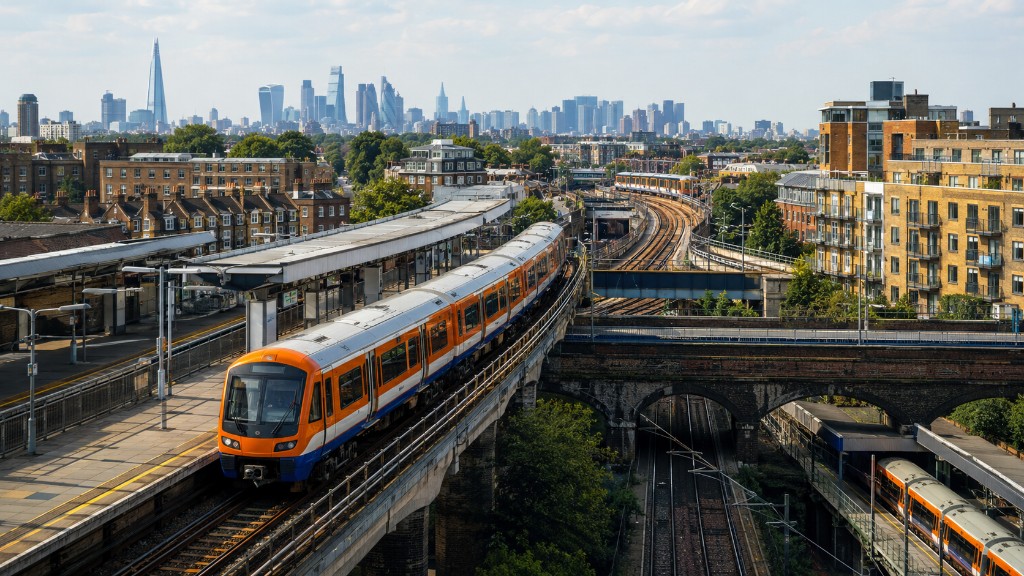
The London Overground is one of the most useful parts of London’s transport network, especially for people who live outside the most central Tube corridors. It connects many neighbourhoods that the Underground does not serve well, links outer and inner London, and makes cross-London travel easier without always going through Zone 1. For renters, commuters, students and newcomers, understanding the Overground can make London feel much simpler.
Unlike the Underground, which is mostly radial and focused on central London, the Overground often works like a set of orbital and connecting rail routes. It helps people travel between areas such as Hackney, Dalston, Highbury, Camden, Stratford, Canada Water, Peckham, Clapham Junction, Richmond, Willesden Junction, Gospel Oak, Barking Riverside, Enfield, Cheshunt, Chingford, Romford and Upminster. It is especially important in East, North, South East and West London neighbourhoods where Tube coverage is limited.
The Overground is run as part of the TfL network, so you can use Oyster, contactless, Travelcards and daily/weekly fare capping in the same broad way as Tube, DLR and Elizabeth line journeys. TfL states that pay-as-you-go fares apply on Tube, DLR, London Overground, Elizabeth line and National Rail services in London, with peak fares Monday to Friday between 06:30–09:30 and 16:00–19:00, and off-peak fares at other times, subject to specific rules. See our Transport basics guide for tapping rules, caps and common payment mistakes.
For years, the Overground appeared on maps as one orange network, which made it harder for newcomers to understand. TfL changed this by giving the six Overground routes individual names and colours. The six named lines are Mildmay, Windrush, Weaver, Suffragette, Lioness and Liberty. TfL’s Made by TfL blog explains that the change was designed to make the network easier to navigate and to celebrate London’s diverse culture and history.
This guide explains what the London Overground is, how the lines work, how zones and fares apply, where it connects, and why it matters so much for everyday London travel.
What is the London Overground?
The London Overground is a suburban rail network managed by Transport for London. It uses National Rail-style tracks and trains, but it is integrated into the TfL system. In practical terms, that means you can treat it much like the Tube for payment, route planning and everyday travel.
You tap in and tap out with Oyster or contactless. You can use the TfL Go app, TfL Journey Planner, station maps and live status updates. Stations use TfL-style signage, and the Overground appears on Tube and rail maps.
The Overground is especially useful because it fills gaps between Tube lines. London’s Underground network is famous, but it does not cover every area equally. Large parts of South East London, East London and North London rely heavily on rail, buses and Overground rather than Tube. The Overground makes those areas more connected.
For example, someone living in Peckham can use the Overground to reach Canada Water, Shoreditch High Street, Highbury & Islington or Clapham Junction. Someone living in Hackney can reach Stratford, Camden, Highbury, Liverpool Street routes or north London connections. Someone in Gospel Oak can travel east-west without needing to go into central London.
The Overground is not one single line. It is a group of routes. That is why the new line names matter.
The six London Overground lines
TfL’s new Overground naming system divides the network into six named lines, each with its own colour. TfL says each of the six routes now has its own colour and that passengers can follow the correct line and colour for their journey, changing to other lines where necessary, just like on the Tube.
The six lines are:
- Mildmay line
- Windrush line
- Weaver line
- Suffragette line
- Lioness line
- Liberty line
Each line serves a different part of London and has a different role in the network. Use the TfL Overground map to see routes, zones and interchange stations.
Mildmay line
The Mildmay line runs between Richmond / Clapham Junction and Stratford. This is one of the most useful east-west Overground routes. It connects West and South West London with North and East London without going through central Tube interchanges.
Important places on or near the Mildmay line include:
- Richmond
- Kew Gardens
- Gunnersbury
- Willesden Junction
- Kensal Rise
- West Hampstead
- Finchley Road & Frognal
- Hampstead Heath
- Gospel Oak
- Camden Road
- Highbury & Islington
- Canonbury
- Dalston Kingsland
- Hackney Central
- Homerton
- Hackney Wick
- Stratford
- Clapham Junction branch
TfL’s own blog describes the Mildmay line as running from Richmond and Clapham Junction to Stratford.
This line is extremely useful for people living in Hackney, Camden, West Hampstead, Richmond, Kew, Willesden or Stratford. It also connects to important interchanges such as Highbury & Islington, Willesden Junction and Stratford.
For renters, the Mildmay line is important because it supports neighbourhoods that feel well connected without needing a Tube station directly outside. Hackney Central, Hackney Wick, Homerton and Camden Road are good examples.
Windrush line
The Windrush line runs between Highbury & Islington and New Cross / Clapham Junction / Crystal Palace / West Croydon. It is one of the most important Overground routes for East and South East London. TfL’s blog describes the Windrush line route as Highbury & Islington to New Cross, Clapham Junction, Crystal Palace and West Croydon.
Important places include:
- Highbury & Islington
- Canonbury
- Dalston Junction
- Haggerston
- Hoxton
- Shoreditch High Street
- Whitechapel
- Canada Water
- Surrey Quays
- New Cross
- Peckham Rye
- Denmark Hill
- Clapham High Street
- Wandsworth Road
- Clapham Junction
- Crystal Palace
- West Croydon
This line is one of the strongest examples of how the Overground changed London. Before the East London line became part of the Overground network, many of these journeys were less straightforward. Now someone can travel from Peckham to Shoreditch, from Canada Water to Dalston, or from Whitechapel to Clapham Junction without relying on central Tube routes.
The Windrush line is especially useful for:
- Peckham
- New Cross
- Canada Water
- Shoreditch
- Hoxton
- Dalston
- Highbury
- Clapham Junction
- Crystal Palace
- Croydon
It is also valuable because of interchanges. At Canada Water, passengers can change to the Jubilee line. At Whitechapel, there are connections with the Elizabeth line, District line and Hammersmith & City line. At Highbury & Islington, there are Victoria line and rail connections. At Clapham Junction, there are extensive National Rail connections.
For South East London renters, the Windrush line is one of the reasons areas like Peckham, New Cross and Brockley feel more connected than they used to.
Weaver line
The Weaver line runs from Liverpool Street to Enfield Town / Cheshunt / Chingford. TfL’s blog explains that the name refers to East London’s textile trade, especially around Liverpool Street, Spitalfields, Bethnal Green and Hackney.
Important places include:
- Liverpool Street
- Bethnal Green
- Cambridge Heath
- London Fields
- Hackney Downs
- Seven Sisters
- Stoke Newington
- Edmonton Green
- Enfield Town
- Cheshunt
- Chingford
This line is important for North East London commuters. It connects residential areas such as Hackney, Stoke Newington, Clapton, Edmonton, Enfield and Chingford with Liverpool Street and the City.
For people working near Liverpool Street, Moorgate, Shoreditch or the City, the Weaver line can be very practical. It is also important for areas that do not have a nearby Tube station. Stoke Newington, for example, relies heavily on buses and rail/Overground services rather than the Underground.
The Weaver line also shows why the Overground should not be judged like the Tube. Some routes feel more like suburban rail, with branches and commuter patterns, but the payment and network integration make them part of everyday TfL travel.
Suffragette line
The Suffragette line runs between Gospel Oak and Barking Riverside. This route was previously often known informally as the “Goblin”, from Gospel Oak to Barking. It now extends to Barking Riverside.
Important places include:
- Gospel Oak
- Upper Holloway
- Crouch Hill
- Harringay Green Lanes
- Blackhorse Road
- Walthamstow Queen’s Road
- Leyton Midland Road
- Wanstead Park
- Barking
- Barking Riverside
This line is useful because it connects North London and East London across areas that are not always well served by direct Tube routes. It also connects to the Victoria line at Blackhorse Road, the District and Hammersmith & City lines at Barking, and other rail services.
For residents in Walthamstow, Tottenham, Harringay, Gospel Oak, Leyton and Barking, the Suffragette line can be a useful orbital route. It may not be the first line tourists learn, but it is very important for local journeys.
Lioness line
The Lioness line runs between Euston and Watford Junction. It serves parts of North West London and Hertfordshire, connecting central London with places such as Wembley, Harrow and Watford.
Important places include:
- London Euston
- South Hampstead
- Kilburn High Road
- Queen’s Park
- Willesden Junction
- Harlesden
- Wembley Central
- Harrow & Wealdstone
- Watford Junction
This line is useful for commuters and for connections with Bakerloo line services around Queen’s Park, Willesden Junction and Harrow & Wealdstone. It also links with National Rail at Euston and Watford Junction.
The Lioness line is less central to many tourist journeys, but it matters for people living in North West London who need access to Euston, Wembley, Harlesden, Kilburn or Watford.
Liberty line
The Liberty line runs between Romford and Upminster. TfL describes the Liberty line as linking the borough to the rest of London, including by connecting it to the Elizabeth line, and says the name reflects the area’s unique independence.
Important places include:
This is the shortest and most separate Overground route. It is important locally, especially for connections between Romford, Emerson Park and Upminster. At Romford, passengers can connect with the Elizabeth line and National Rail services. At Upminster, there are District line and rail connections.
For most central London visitors, the Liberty line is unlikely to be part of daily travel. For local residents in Havering, it provides a useful connector.
How zones work on the Overground
The Overground uses the London fare zone system. That means fares depend partly on which zones you travel through. Central London is Zone 1, with zones expanding outward to Zones 2, 3, 4, 5, 6 and beyond in some areas.
TfL’s Tube and rail fare guidance applies to London Overground, DLR, Tube, Elizabeth line and National Rail services where pay-as-you-go is accepted. Peak fares generally apply Monday to Friday between 06:30–09:30 and 16:00–19:00, with off-peak fares at other times, subject to route-specific rules.
The main practical points are:
- Tap in at the start of your Overground journey.
- Tap out at the end.
- Use the same Oyster card, contactless card or mobile wallet.
- Your fare depends on zones and time of day.
- Daily and weekly capping can apply.
Some stations are in two zones. This can affect fare calculations. TfL’s Overground map includes station zone information and notes where stations sit in both fare zones.
For commuters, zones matter when choosing where to live. A flat near an Overground station in Zone 2 or Zone 3 may be more affordable than central areas while still giving good connections. But the total cost should include both rent and transport.
Oyster, contactless and capping
You can use Oyster or contactless on the London Overground. TfL says pay-as-you-go fares in Zones 1–9 are capped, so you can travel as much as you like in one day or week, Monday to Sunday, without paying more than the cap for the zones travelled.
For most adults, contactless is the easiest way to pay. Use a bank card or mobile wallet and tap in and out. Oyster is still useful if you want to load a Travelcard, use certain discounts or keep travel spending separate from your bank card. See Transport basics for the full picture on caps, peak times and payment mistakes.
The most important rule is:
Always use the same card or device for the whole journey.
Do not tap in with your phone and tap out with your physical card. Even if both use the same bank account, TfL may treat them as separate payment methods.
On Overground, unlike buses, you must tap out. If you do not, you may be charged a maximum fare.
How the Overground connects London
The Overground’s biggest strength is connection. It links neighbourhoods that historically felt separated. It also allows many journeys without going through central London.
Examples:
- Hackney Central to Stratford
- Peckham Rye to Canada Water
- Dalston Junction to Shoreditch High Street
- Highbury & Islington to Clapham Junction
- Gospel Oak to Barking Riverside
- Liverpool Street to Chingford
- Romford to Upminster
- Richmond to Hackney Wick
This matters because London is not only a centre-and-suburb city. People work, study, socialise and move across many local centres. The Overground helps connect those centres.
It is especially valuable for renters. A neighbourhood without a Tube station may still be very attractive if it has a good Overground station. Hackney, Peckham, Brockley, Walthamstow, Gospel Oak, Homerton, Hackney Wick and New Cross are examples where Overground access can significantly improve connectivity.
Useful interchanges
Some Overground stations are especially important because they connect with Tube, Elizabeth line, DLR or National Rail.
Important interchanges include:
- Stratford — Central, Jubilee, Elizabeth line, DLR, National Rail
- Highbury & Islington — Victoria line, National Rail
- Canada Water — Jubilee line
- Whitechapel — Elizabeth line, District, Hammersmith & City
- Liverpool Street — Elizabeth line, Central, Circle, Hammersmith & City, Metropolitan, National Rail
- Clapham Junction — major National Rail interchange
- Willesden Junction — Bakerloo line and Overground routes
- Blackhorse Road — Victoria line
- Barking — District, Hammersmith & City, National Rail
- Euston — Northern, Victoria, National Rail nearby
- West Hampstead — Jubilee line, Thameslink nearby
These interchanges make the Overground much more powerful than it may first appear. A journey may start on the Overground, then connect quickly to the Tube or Elizabeth line.
Overground vs Tube
The Overground is not exactly the same as the Tube.
The Tube is mostly an underground metro network with high frequency, especially in central areas. The Overground uses suburban rail infrastructure, often above ground, with routes that can feel more like trains than Tube lines.
Main differences:
- Overground trains usually run above ground.
- Frequencies can be lower than central Tube lines.
- Routes may branch.
- Stations may feel more like rail stations.
- It is very useful for orbital and cross-neighbourhood travel.
But for payment and planning, the Overground is integrated with TfL. You can use the same Oyster/contactless system and TfL journey tools.
For newcomers, the simplest way to think about it is:
- The Tube gets you through central London.
- The Overground connects many neighbourhoods around and across London.
When the Overground is better than the Tube
The Overground can be better than the Tube when:
- You are travelling around London rather than into Zone 1.
- You live in an area without a Tube station.
- You want to avoid central interchanges.
- You are connecting to Stratford, Canada Water, Clapham Junction or Highbury.
- You are travelling between East and South East London.
- You are going to Hackney, Peckham, Brockley, Dalston or Gospel Oak.
For example, Peckham Rye to Shoreditch High Street is much easier on the Overground than by Tube. Hackney Central to Stratford is straightforward on the Overground. Canada Water connects Overground users to the Jubilee line quickly.
Common mistakes
- Ignoring the Overground because it is not the Tube. In many areas, it is the most important rail connection.
- Assuming all orange lines go the same way. With the new names and colours, this is easier, but passengers still need to check the destination.
- Not tapping out. Overground journeys require tap in and tap out.
- Choosing a home only by Tube access. Some Overground areas are better connected than they look.
- Forgetting weekend engineering works. Overground routes can be affected by planned works, so always check before important journeys.
- Buying a pass before knowing your routine. If you work hybrid, pay-as-you-go may be cheaper than a monthly Travelcard.
Best areas for Overground access
Some of London’s most attractive rental areas are strongly connected by Overground.
Good examples include:
- Hackney Central
- Hackney Wick
- Homerton
- Dalston
- Canonbury
- Highbury
- Peckham Rye
- Brockley
- New Cross
- Canada Water
- Walthamstow
- Gospel Oak
- Camden Road
- West Hampstead
- Richmond
- Stratford
- Clapham Junction
These areas can be especially good for people who want neighbourhood life rather than only central commuting. Explore our area guides for Hackney, Peckham, Stratford, Clapham, Islington and Bethnal Green.
Final summary
The London Overground is one of the most important parts of London’s transport system. It connects neighbourhoods, fills gaps in the Tube network, supports orbital travel and makes many areas more liveable. With the six named lines — Mildmay, Windrush, Weaver, Suffragette, Lioness and Liberty — the network is easier to understand than it used to be.
Use Oyster or contactless, tap in and out, check zones, and pay attention to line names and destinations. The Overground is especially useful if you live in Hackney, Peckham, Dalston, Stratford, Canada Water, Clapham Junction, Walthamstow, Richmond, Gospel Oak, Enfield, Chingford or Barking Riverside.
The honest summary is simple: the Overground is not just a secondary rail network. For many Londoners, it is the line that makes their neighbourhood work. It connects places the Tube does not, reduces the need to travel through Zone 1, and opens up some of London’s most interesting areas for renters, commuters and newcomers.