
London Bus Network Explained for Newcomers
Contactless tap-in, Hopper fare, night buses, stop letters, flat fares and how buses connect with Tube stations on CheckLondon.
Overview
Moving to London can feel overwhelming at first — the Underground map looks like a colourful puzzle, train zones can be confusing, and suddenly you’re hearing route numbers like 38, 73 or N25 in everyday conversation. But there is one part of the transport system that is far easier than it looks: the London bus network.
For many Londoners, buses are not just a backup to the Tube — they are the daily backbone of commuting, especially in areas where Underground lines are limited. The London bus network is one of the largest and most connected urban bus systems in the world. Once you understand how it works, you’ll discover it is affordable, accessible, and often more practical than the Underground.
At CHECKLONDON, each station profile page can show bus stops near major Underground and rail hubs — for example Oxford Circus, Waterloo or Victoria — helping you connect Tube and bus routes across the city. For Oyster, contactless, zones and caps, start with our Transport basics guide.
How to pay: contactless and Oyster
The first thing newcomers need to know is that London buses are completely cashless. You cannot pay with coins or notes. Instead, you use contactless bank cards, Apple Pay, Google Pay, or an Oyster card. Simply tap your card on the yellow reader when you board.
Unlike the Underground, you do not tap out when you leave. Bus fares are flat-rate, which makes the system simple and predictable. See TfL contactless and Oyster fares on buses for current prices.
Hopper fare
One of the most useful features for new arrivals is the Hopper fare. This allows you to transfer between multiple buses within one hour of your first tap without paying again. For example, if you take Bus 24 and then change to Bus 29 within 60 minutes, you will only be charged once. This makes buses extremely cost-effective for short and medium journeys.
Unlike the Tube, bus fares are the same regardless of distance. Whether you travel two stops or cross several zones, the price remains fixed. This is especially useful in outer London, where Tube journeys can become expensive across zones.
Route numbers, destinations and bus stops
Each bus operates on a numbered route. The number appears clearly on the front, side, and rear of the vehicle, along with the final destination. Always check both the route number and the destination before boarding. In central London, the same stop may serve multiple buses heading in different directions.
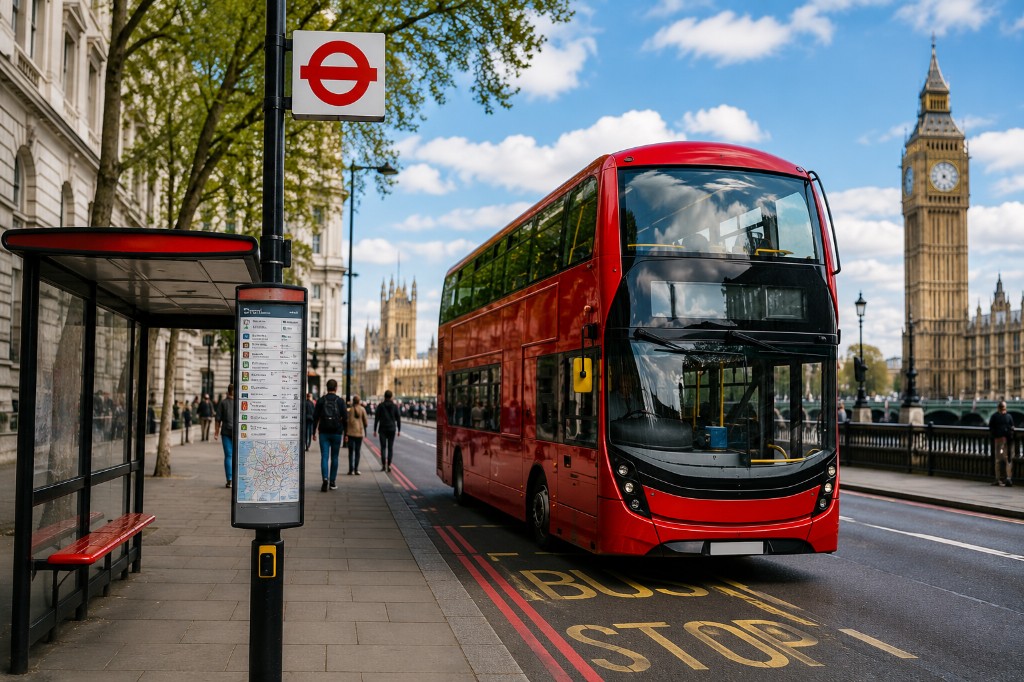
Bus stops are easy to recognise thanks to London’s iconic red roundel sign. Every stop has a letter designation, such as “Stop A” or “Stop D.” This is important because different stops with the same name can be located on opposite sides of the road. When using navigation apps, always confirm the stop letter to avoid waiting in the wrong place.
Many bus stops serve several routes. The sign at the stop lists all the bus numbers that call there. In busy areas, buses may arrive every few minutes. In outer areas, the frequency may be every 10 to 20 minutes. Use TfL Journey Planner or the TfL Go app for live arrivals.
Night buses
Night buses are another key feature of the London network. These routes operate after the Underground closes. They are marked with an “N” before the route number, such as N15 or N109. If you plan to stay out late, knowing your nearest night bus route can save you from expensive taxi fares. Our Transport basics guide also covers Night Tube and late travel options.
Why buses are worth using
One of the best parts of travelling by bus is the view. Unlike the Underground, which runs below ground in many areas, buses allow you to see London’s streets, architecture and parks. Sitting upstairs at the front of a double-decker bus gives you a panoramic city experience. Routes through central London — past landmarks near Westminster, Victoria or Tower Hill — can even double as informal sightseeing tours.
Buses are particularly important in South London, where Underground coverage is more limited. In many neighbourhoods such as Peckham, Clapham and Greenwich, buses are the main form of public transport. They connect residential streets with train stations and Underground hubs like Stockwell, Brixton and London Bridge.
Connecting buses with the Tube
One of the biggest advantages of the bus system is how well it links to Tube stations. On CHECKLONDON, station pages for major hubs such as Oxford Circus, Stratford, Waterloo and King’s Cross show nearby bus stops and the routes serving them. This makes it easy to plan journeys that combine Tube and bus travel efficiently.
For example, if you exit a Tube station and need to reach a residential street not directly connected by rail, nearby bus stops usually provide onward travel options. Many stations have bus stops directly outside or within a short walking distance.
Understanding how buses connect with Underground stations is especially useful for commuters. Many Tube stations serve as major bus interchanges, allowing seamless transfers between rail and road networks. You can also read our London Overground explained guide for orbital rail connections where buses fill remaining gaps.
Accessibility and getting off
All London buses are wheelchair accessible. They have low-floor entry and a kneeling function to assist passengers. There are designated spaces for wheelchairs and priority seating for those who need it. Audio and visual announcements clearly state each stop, making it easier for newcomers to follow their route. See TfL accessibility guidance for full details.
To get off the bus, press one of the red “Stop” buttons located throughout the vehicle. A bell will sound, and a “Bus stopping” message will appear. There is no need to press multiple times. If nobody presses the button and no one is waiting at the stop, the bus may continue without stopping.
Rush hour, bus lanes and planning
Traffic can affect bus journey times, especially during rush hour between approximately 7:00 and 9:30 in the morning and 4:30 to 7:00 in the evening. However, many roads include dedicated bus lanes marked in red. These lanes allow buses to bypass heavy traffic in peak hours, improving reliability.
Planning bus journeys is straightforward using apps such as Citymapper or Google Maps. These apps provide live bus arrival times and show exactly which stop letter you need. Many central stops also have electronic countdown boards showing how many minutes remain until the next bus arrives.
Safety on London buses is generally good. All buses are fitted with CCTV. Drivers are trained professionals, and serious incidents are rare. As in any major city, remain aware of your belongings, particularly late at night.
Direction, mistakes and daily habits
For newcomers, the key to mastering the bus system is understanding direction. Always check the destination displayed on the front of the bus. The same route number will run in two opposite directions, each with a different final destination.
If you board the wrong bus by mistake, do not worry. Simply get off at the next stop and recheck your route. If you are still within the Hopper fare window, changing buses will not cost extra.
During quieter hours, buses can be one of the most pleasant ways to travel. They are often less crowded than the Tube and allow you to enjoy London at street level. For short journeys of one or two miles, buses are frequently more convenient than walking to and from Underground stations.
The London bus network operates extensive coverage across Greater London. It connects central business districts, suburban communities, parks, shopping centres, universities and hospitals. Whether you live in Zone 1 or further out, buses are likely part of your daily routine.
Over time, you will likely develop familiarity with certain route numbers. Londoners often refer to buses by number as shorthand — “take the 38,” “catch the 73,” “the 24 goes there.” These routes become part of daily life.
Final summary
In summary, the London bus network is affordable, accessible, extensive and beginner-friendly. With flat fares, contactless payment, frequent services and strong connections to Underground stations, buses are one of the easiest ways to move around the city.
Once you understand the basics — tap in, check the route number and destination, press stop when needed — you will find London buses simple to use. And with CHECKLONDON station pages highlighting bus stops near Tube stations, navigating the city becomes even easier.
For newcomers, buses are not just transport. They are your introduction to London at street level. Combine them with our guides on Transport basics, Cycling in London and London Overground to build a complete picture of how to get around like a local.