
Elizabeth Line — The complete guide
Crossrail explained: central stations, interchanges, Heathrow, fares, step-free access and east–west travel habits for newcomers.
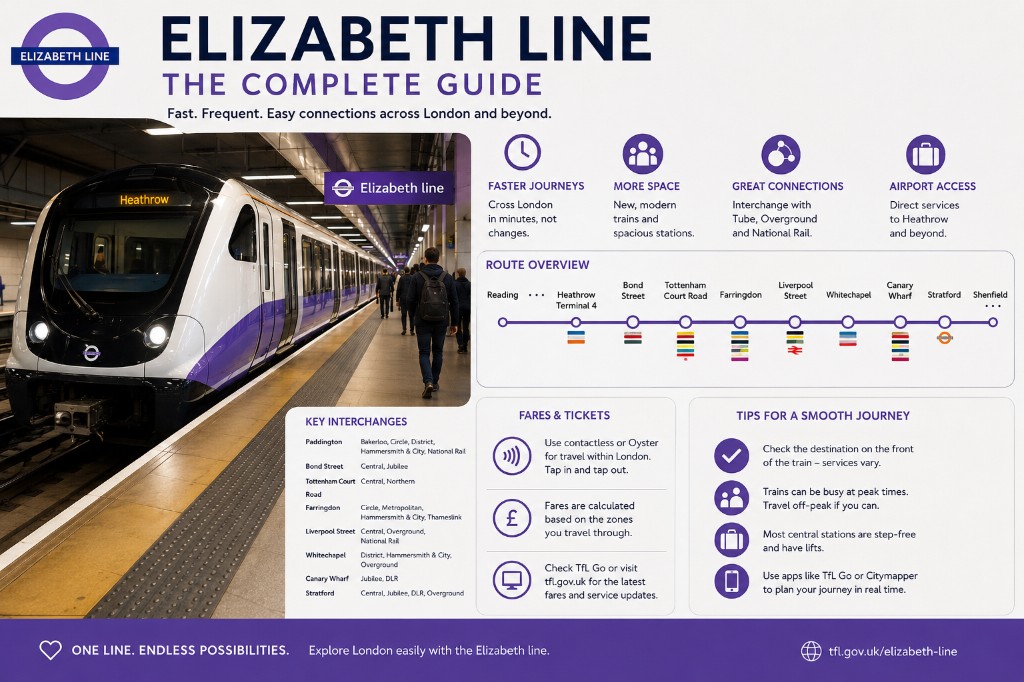
The Elizabeth line (sometimes still called “Crossrail”) is one of the biggest upgrades to London transport in decades. If you’re new to the city, it can feel like “just another Tube line,” but it’s different: it runs through central London like a super-fast spine, connects key stations that used to require awkward changes, and makes east–west travel dramatically easier. Once you understand how it fits into the wider network, you’ll use it constantly — for commuting, airports, shopping trips, and day-to-day moving around.
Start with our transport basics guide for Oyster, contactless and fare caps. For airports, see Heathrow to Central London. For how the Elizabeth line fits with buses, Overground and cycling, see getting around London without a car and London Overground explained.
What the Elizabeth line is
The simplest way to think about the Elizabeth line is this: it’s a high-capacity rail line that links outer London (and beyond) to central London through a set of deep-level stations in the middle. In the centre, it feels like a modern Tube experience — big platforms, wide trains, strong air flow, frequent services — but on the ends it behaves more like a mainline railway, with longer distances, faster speeds, and stops that stretch out into suburbs and commuter towns.
This hybrid nature is exactly why it’s so useful. It’s not replacing the Tube; it’s removing the painful parts of cross-city travel that used to take too long.
Why it changes London travel
What makes the Elizabeth line a game-changer is where it goes. It connects places that matter in real life: major rail hubs, business districts, shopping centres, and residential corridors.
In central London, the stations people use the most are:
- Paddington — National Rail, Bakerloo, Circle, District, Hammersmith & City
- Bond Street — Central and Jubilee; West End shopping
- Tottenham Court Road — Central and Northern; Soho and theatres
- Farringdon — Thameslink, Circle, Metropolitan, Hammersmith & City
- Liverpool Street — Central, Overground, National Rail; the City
- Whitechapel — District, Hammersmith & City, Overground
- Canary Wharf — Jubilee, DLR; see our Canary Wharf area guide
Each of these is a powerful interchange:
- Paddington links to National Rail and the Bakerloo, Circle, District and Hammersmith & City lines — useful for west London and connections toward Westminster and beyond.
- Bond Street links to the Central and Jubilee lines and drops you into the West End shopping core.
- Tottenham Court Road connects with the Central and Northern lines and puts you near Soho, Oxford Street and the theatre district.
- Farringdon is huge for commuters: Thameslink plus Circle, Metropolitan and Hammersmith & City — one of the best “switch points” in the entire city.
- Liverpool Street is a major hub for the City, Overground connections and National Rail routes.
- Whitechapel is an east London connector with District and Hammersmith & City lines and Overground nearby; see Bethnal Green area guide for the wider neighbourhood.
- Canary Wharf on the Elizabeth line gives a fast, direct corridor into a major business zone in Tower Hamlets.
Further east, Stratford links Central, Jubilee, DLR, Overground and National Rail — see Stratford area guide for housing and Olympic Park context.
Time saved on cross-city journeys
For many newcomers, the most impressive change is the time saved. Journeys that used to feel like multi-change puzzles become direct and smooth. For example, moving from east London into the West End: you can go from Canary Wharf to Bond Street without the usual switching between Jubilee and Central lines, or weaving through busy interchange stations.
If you work in one part of the city and live far across town, the Elizabeth line often removes one stressful interchange and replaces it with a single ride.
Service patterns and destinations
In the central section, trains are frequent, and the stations are built for high flow: wide escalators, clear signage, and generally more space than older Tube stations. On the outer branches, train frequency can be less intense than the central core, and stopping patterns can vary.
That’s why checking the destination on the front of the train matters more than on most Tube journeys. You’ll often see different endpoints listed (Reading, Heathrow, Shenfield, Abbey Wood and others). In practical day-to-day use, apps like TfL Go, Citymapper or Google Maps will normally handle this for you, but it’s still worth building the habit of checking destination boards on the platform.
Heathrow and airports
Airports are a big reason people love the Elizabeth line. It offers a straightforward rail route to Heathrow that is usually cheaper than premium express services, and more comfortable than some older lines. For newcomers, this is a major quality-of-life improvement: you can get from central London to Heathrow without thinking too hard.
Just remember that Heathrow has multiple terminals, so always check which terminal you need and follow station signs carefully when you arrive. If you’re travelling with luggage, you’ll appreciate the modern stations, wide corridors and smoother boarding compared with many Tube routes. Full comparison: Heathrow to Central London.
Where to live and commute
The Elizabeth line also changes how you should think about where to live. London housing decisions often depend on commute time, and the Elizabeth line redraws those mental maps. Areas that once felt “too far” can become realistic if they’re served by the line.
That doesn’t mean every area becomes perfect — commute is only one factor — but it expands options. If you’re house-hunting, test real commute routes using the Elizabeth line during your actual commute hours. In London, a commute that looks good on paper can feel very different at 8:30am.
Compare areas with our best areas for young professionals, renting in London as a foreigner, cost of living in London, and the London boroughs hub. Corridors through Newham, Stratford and Ealing are especially well served.
Fares, Oyster and contactless
In most London travel, you pay using contactless bank card, Apple Pay/Google Pay, or an Oyster card. The Elizabeth line is part of that ecosystem for journeys within London zones — you tap in and out like the Tube.
Because the line extends into areas that can be outside typical Tube zones and behaves like a railway in places, fare logic can feel closer to National Rail for those outer segments. You don’t need to memorise the details; just remember the rule: tap in at the start, tap out at the end, and your system will calculate the correct fare. If you want maximum clarity, register your contactless card with TfL so you can review journey history and charges.
See transport basics for caps, peak/off-peak and common mistakes. For other airports, compare Gatwick to London.
Modern stations and comfort
Elizabeth line stations in central London are designed for higher capacity and comfort: wide platforms, better ventilation, and clear directional flow. Compared with older Tube stations, many people find them less stressful, especially at peak times. If you’re a newcomer who finds London transport intimidating, the Elizabeth line is often a calmer “first line” to learn.
Step-free access
Many Elizabeth line stations were built or upgraded with step-free access in mind, which can be a major benefit if you have a buggy, luggage, mobility challenges, or simply prefer avoiding stairs. London is improving step-free access overall, but older stations can still be difficult; the Elizabeth line helps fill that gap in the centre. Use TfL accessibility guides or app filters when planning.
Using it as your east–west spine
The best approach is to treat the Elizabeth line as your high-speed spine across the city and then use local lines, buses, or short walks to finish the last mile. For example, you might use the Elizabeth line to cross central London quickly, then switch to a short bus ride or a single Tube stop for the final leg.
London journeys are often about combining the right layers. The Elizabeth line is excellent for the “big move,” and buses or walking are often better for the final neighbourhood stretch. Cycling in London can work for the last mile in some areas.
Habits for a smoother journey
Choose the right station entrance
Stations like Liverpool Street and Paddington are huge and have multiple entrances; choosing the wrong side can add unnecessary walking. Apps help, but you’ll learn through experience.
Know your power interchanges
- Farringdon — Thameslink, Circle, Metropolitan
- Bond Street and Tottenham Court Road — West End
- Liverpool Street — the City
- Canary Wharf — east business district
- Stratford — Central, Jubilee, DLR, Overground
Don’t underestimate walking
One of the best tricks in central London is to combine the Elizabeth line with short walks rather than unnecessary line changes. If you arrive near the West End, a 10–15 minute walk can be easier than switching lines for one stop.
Peak patterns
Like all major London lines, the Elizabeth line can be very busy during commuting hours. If you have flexibility, travelling slightly outside peak can make the ride far more comfortable.
Exploring London on the Elizabeth line
For exploring London, the Elizabeth line has a “city discovery” advantage. It connects areas that represent different versions of London: classic West End, creative Soho adjacency, financial City zones, multicultural east London, modern Canary Wharf, and onward routes toward suburban landscapes.
You can plan a day around it: shopping at Bond Street, a meal near Tottenham Court Road, a riverside walk from Canary Wharf, and a quick hop back — often without feeling like you’ve spent the day trapped on the Tube. See free things to do in London and markets near Tube stations for budget ideas.
Think in station hubs
People don’t experience transport lines as abstract maps; they experience them as stations they enter and exit. Think in hubs: where do you start, where do you change, where do you arrive, and what’s nearby. That’s the mental model that helps a newcomer move from “confused” to “confident.”
New to London? Start with your first weeks in London and moving to London practical checklist, then build your routes around the Elizabeth line spine.
Final thoughts
The biggest advantage: the Elizabeth line reduces complexity. London transport can feel intimidating because it has layers (Tube, Overground, National Rail, buses). The Elizabeth line simplifies a big chunk of the city by creating a clean east–west backbone with strong interchanges.
The more you use it, the more London starts to feel smaller and more navigable. Official route and status updates: tfl.gov.uk/elizabeth-line.